
Mugen Noh Othello-Costume plan

Adapted from: Othello by William Shakespeare
Direction: Satoshi Miyagi
Text: Sukehiroi Hirakawa
With: SPAC-Shizuoka Performing Arts Center
Production: Shizuoka Performing Arts Center

In June 2026, this production will be presented as the opening performance of the Theatre Section of the Venice Biennale. As the costume designer for this work, I am deeply honored by the opportunity to be part of this remarkable occasion.
The costume concept has sparked curiosity among some audience members after the show. I would therefore like to take this opportunity to share some of the ideas and inspirations that informed the design.
One of the distinctive features of Othello is its performance method, in which two actors share a single role: one embodies the physical movement of the character, while the other speaks the text. This unique theatrical language creates a richness that is both bold and sensitive, offering a quality unlike anything found in conventional drama. Designing costumes for such a production taught me a great deal about the relationship between body, voice, and presence on stage.
Among the many elements of this work, what resonated most deeply with me was the beauty of Sukehiro Hirakawa’s Noh text and the performance of the Jiutai (Speakers), whose approach to language rendered it almost like music.
Then, during rehearsals, something unexpected happened. The voices of the Speakers seemed to permeate my entire body. Although the language was classical and unfamiliar, I found myself captivated by its rhythm and texture. Even days after the performance, the sound of the chanting remained with me.
It was then that I realized where my attention truly belonged. The heart of this production, at least for me, was its auditory energy of Yokyoku(text).
When the opportunity arose to redesign the costumes for the revival, I decided to build upon that realization. To my eyes, Othello is a work whose auditory energy surpasses its visual energy. Therefore, my goal became to support the beauty of the text through visual means, enhancing it with imagery.
The first image that came to mind was that of resonance. I wanted to create costumes that could embody the lingering echoes of voices and words—the invisible traces that remain long after a performance has ended.
However, the revival featured different Speakers, and the production's atmosphere shifted accordingly. As a result, the balance between auditory and visual elements changed, and I felt that the visual aspect needed a stronger presence.
In the final stage of the design process, I introduced bold hiragana 3-dimensional motifs on the costumes. My costume design process always involves a keen awareness of their integration into the production. If the costumes become too dominant, they may diminish the text's power. If they are too restrained, they may fail to contribute sufficiently to the overall theatrical experience.
The performers who embody movement are essential, but so too are the performers who carry the words. Their energy became an equally important part of my design process, driving my approach.
The costumes were therefore conceived as companions that would enhance the resonance of the play. They are intended to support and amplify the lingering beauty of the Noh text, helping its energy remain with the audience long after they leave the theatre, creating a lasting impression.
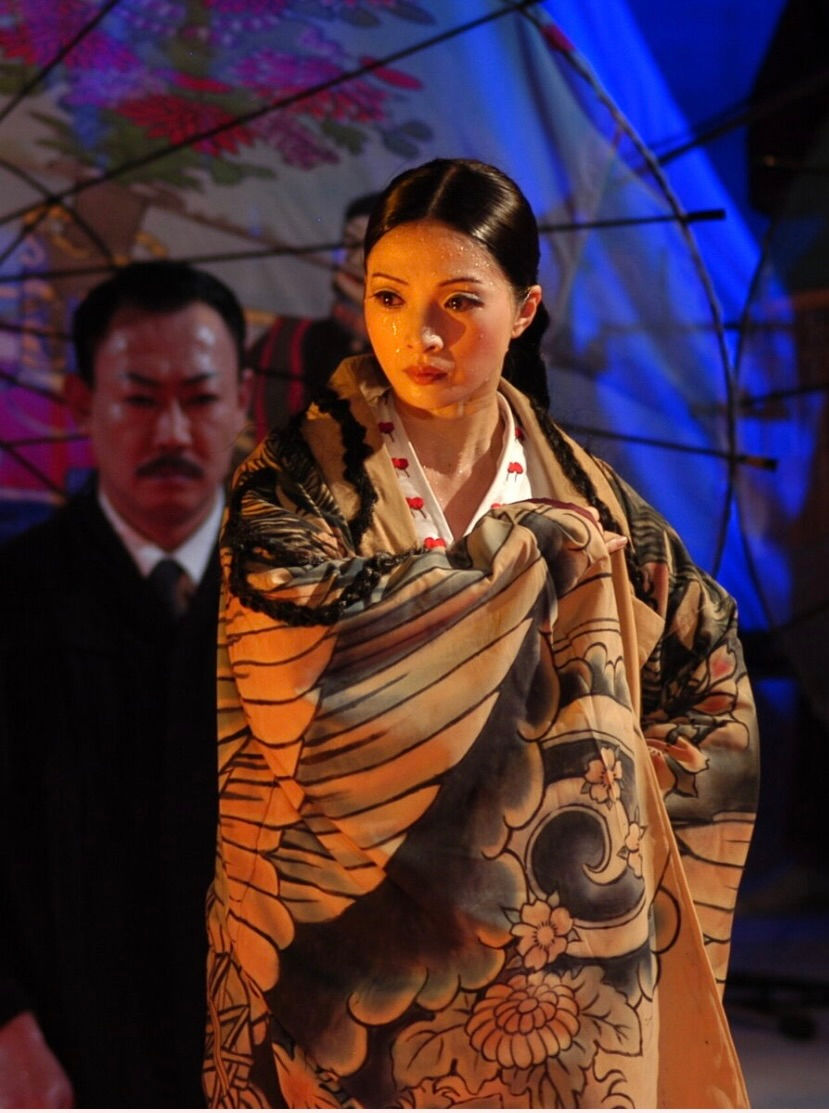
Desdemona’s costume is composed of multiple layers of delicate silk organza, subtly evoking the silhouette of traditional Noh garments. Upon each layer, passages from the Noh text are inscribed, forming a visual narrative. As the translucent layers overlap and move, the characters drift across one another, appearing and disappearing in the light. To me, they resemble the unspoken emotions overflowing within Desdemona’s solitary soul, a reflection of her inner world.

I would like to express my heartfelt gratitude to Eri Fukazawa, whose beautiful calligraphy became an essential part of this design, lending it a unique artistic voice. I am also deeply grateful to the costume department of SPAC, who painstakingly transformed the calligraphy into stencils and hand-dyed the text onto the fabric. Their dedication and exceptional craftsmanship made this vision possible.
Like an echo that continues to drift through space after a voice has faded, I hope these words may continue to resonate upon the costumes and remain, however quietly, within the memories of those who experience this production, leaving a subtle yet enduring impact.


Comments